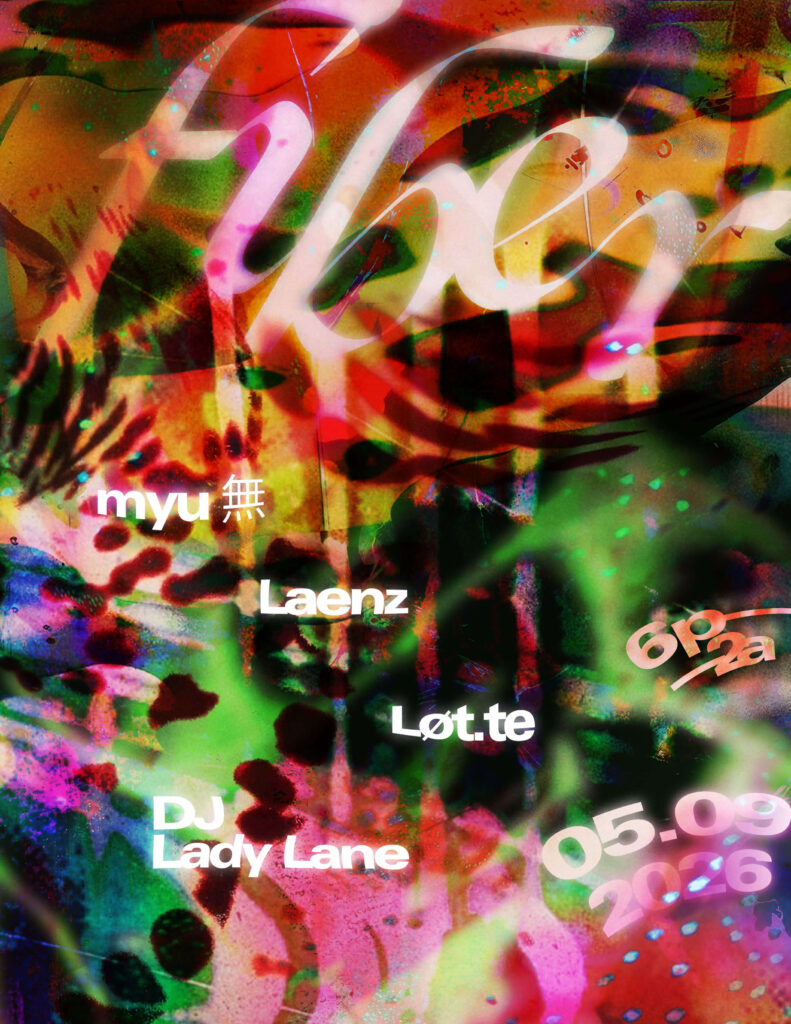
lineup
- myu 無
- Laenz (Live)
- Løt.te (Live)
- DJ Lady Lane
menu
appetizers
- Puba (Fermented Yuca) Sourdough for Livia (Vegan)
- “Fucking Excellent” Beurre de Baratte for Irene (GF)
- Co-milled Kumquat Olive Oil for Kate (Vegan, GF)
- Pollen Garum Bagna Càuda with Blanched Cauliflower, Fennel, and Carrots for Chris X. (GF)
- Bela Gil’s Fermented Cashew Pâté (Vegan)
- Aloo Bhindi Canudos for Amar
- Patra for Rave Mother (Vegan, GF)
- Sri Lankan Amla Pickles (Vegan, GF)
- Olive Oil-Poached Green Almonds (Vegan, GF)
- Kale and Herby Pesto Dip for Ocean (Vegan)
- Red Onion, Chipotle, and Adobo Chili Focaccia (Vegan)
salads
- Bok Choy and Cannellini Bean Salad with Ginger-Maple Dressing (Vegan)
- Konstanz-style Sauerkraut (Vegan, GF)
mains
- Glass Noodles with Pineapple Satay & Quinori Tempeh for Mama Ramma (Vegan, contains nuts)
- Trini Chana and Aloo Curry for Gabby, with accompanying Tamarind Chutney (Vegan, GF)
- Saag for Z (GF)
- Kasha Varnishkes with Mushrooms, Sour Cream, Roasted Apples & Caramelized Onions for Alessandra and Yosef
- Halluski (Cabbage and Noodles) (Vegan)
- Tofu and Tomato Egg Drop Soup for the Asian Diaspora (has sesame)
- Roasted Carrot and Red Lentil Ragout for Sofia M. (Vegan)
desserts
- Pavlova with Passionfruit Chantilly, Labay Fruits, and Nixtamalized Guava for Andrea (GF)
- Baru, Pequi, and Brazil Nut Torrone for Every Mom that Calms Kids Down with Sugar (GF)
- Fromage Blanc Tart with Rose-y Strawberries
- Jackfruit Cake with Jackfruit Pit Marron Glacé for Irene
- Orange Blossom Coconut Manjar with Apricots and Stingless Bee Mandaçaia Honey for Marcia (GF)
- Papaya with Cassis Ice Cream for Mama Chicken
- Apple Ginger Rhubarb Crumble for Giuseppe (Vegan)
- Yet Another Peanut Butter and Chocolate Pie for David (Vegan)
- Banana Snacking Cake with Salted Caramel Glaze for Lou and Clara
- Carrot-Orange Olive Oil Cake
beverages
- RELAX, MOM! Niter Kibbeh Washed Agave and Lime Spritzer (GF)
- Cha Yen (Thai Iced Tea with Condensed Coconut Milk and Oat Milk) (Vegan)
post-midnight snacks
- Fig Leaf Choux
- Kaju Katli for Pre-Diabetic Kiki (Vegan)
lore
Hello hello, friends. We can barely believe it’s May already. Spring this year has been a slow build, going from winter, to summer, to winter, to a long and sniffly wet period where the city’s rent-stabilized apartment buildings are hovering about 1 degree over the temperature at which they need to turn on the heat. Our government continues to fund and wage wars across the Arab world with the help of tech companies who surveil our every stroke and sniffie, suck up diminishing natural resources, lay off workers, calculate kill lists, flood politics with bad money and bad ideas, and promote a world of slop. Our May party is a reflection of this precipice, with a balance of lightness and dark, with paranoid engagements with technologies, and recuperative takes on techno musics that decenter rhythm from the Detroit <> Berlin axes. Last time we wrote about grief and shared the room with some incredible music from Modrums, Contrafuego, and Viiaan, and you can listen back to those sets here, and read back through our words, listen to our live recordings, and cook through our past banquets at fiber.casa.
As always, there will be experimentation, warmth, and food in abundance, this time around the question of mothering and mothers. Listen back to the Rave Cafe’s Unlikely Pairings episode where Aline and Angee talk about the relation between food and parties (and beg for sexiness to come back to the rave), with sets from myu 無 and fuge built solely out of Fiber artists, and then listen back to the ambient radio explorations of FiberFM, every fourth Tuesday on 8ball (next one this Tuesday May 5). Other things on our schedules: Head over to First Friday of May at LSD tonight to see our homies Fedra, Matük, and Prince of Queens. Later next weekend, if you still have energy the morning after Fiber, or if you’re carrying, the mothering will still be happening at Hybrid Identity. Then, later this month, we have a big weekend at the studio: Friday 5/22, when Contrafuego hosts Ebrima Jassey and Sphente, and Saturday 5/23, when fuge and aka-Sol host Endless Spill vol. 3, with Madison Greenstone, G.O.M.A., Ciénega, and Enereph. Watch the Studio’s website or sign up for their newsletter for tickets.
Finally, our friend Geoffrey Mak, author of the great memoir Mean Boys and the upcoming rave novel, Total Depravity, is putting together a course called Rave Methods (with help from our very own Chris/fuge) – rigorously applying contemporary approaches in aesthetic theory from Continental philosophy to queer psychoanalysis, to open up radical possibilities of confrontational leisure, strategic resistance, and collective transformation. This course, mixing lecture and deep conversation, welcomes nightlife workers and producers, and anyone who’s tired of raving on autopilot (or if you just want to understand nightlife with a critical lens and meet the weirdos who would sign up for this kind of thing). This will run every week from July 4th until Honcho, so clear your calendars.
LORE: IS “THE SCENE” REALLY JUST A SITUATIONSHIP?
Moving to NYC is an experience that most of us probably all have had, at one point or another. Some of us came here with connections already, and many of us had none at all. All of us, at one point or another, met people, made friends, and found family through music and dance. As the organizers of Fiber, we all came to NYC as migrants in one way or another. Angee’s family comes from Southern China (and she herself came back to the city after a long stint in Missouri), Jo from Taiwan, Aline from Brazil, Chris from Iowa (still counts!). Today, we often refer to ourselves as community, and the word is used frequently, but what really is a community?
As we get nearer to the second anniversary of our party, we’ve been thinking a lot about what it really means to be a community, as well as learning how much modern life changes the way we relate to one another. When you first meet someone, typically you know them in relation to a shared something they’re involved in or actively do, and you situate them in relation to how you, as a subject, will be involved with them as a conclusion of this formula. The more time you spend together, the more the original object of the relationship falls away and the more you become subjects sharing a plane. Increasing mutual vulnerability and transparency, confirmed with validation and shared presence, builds an actual relationship out of shared risks and kept promises. When enough of these relationships overlap and are intertwined within a group of similar relationships, you have a community.
Juxtapose this to a situationship, a situation where people want to be with each other only to the extent that they’re means to specific needs, while minimizing the actual risks involved. Sure, sometimes it’s fun for everyone involved, but when those means stop leading to those needs and ends, the relationship dies because it was never between two subjects, the original object always kept its primacy, and the people remained in an object relation to one another. Apply that to a party or rave: you pay for a ticket to organizers that you probably don’t actually know, on all sides still embedded in the structures that actually scaffold the “scene”: from racial capitalism to labor politics. Buying a ticket to an event is not inherently supporting an event but a transaction. Attending an event is not inherently making community. The attendee pays their fee, and the organizers use the funds to create an experience that is then ritually consumed. In the case of Fiber as a banquet, beautiful music, free and open dance.
Within the present era, most relationships, especially mediated ones, are consumerist practices embedded in objectification. A business organization with roles and responsibilities immediately circumscribes how individuals engage with one another, for better or worse. Two friends working together and sharing risks to create a party is a symmetrical relationship, different from that of the asymmetrical relationship of a venue owner assigning scope, roles, and responsibilities to workers who are means to ends, exchanging need (labor) for need (pay). If everyone providing services are queer and/or immigrant and/or POCs and/or not-men, and everyone receiving the services are well-paid, economically-stable, partiers, then what does that really reveal about the actual social mechanics of said community, and how does that differ from the larger system? How much risk is actually shared, how much control is shared, how much cost is shared, and by and between whom, and who is really investing in “the community,” this magical entity that is loosely and frequently referenced in our scene?
Actually getting one’s skin in the game, with other people, with shared stakes, and with a vision is what creates community. Giving more than is needed for the occasion is generosity. We, as chosen family who happen to be organizers, have become much closer to one another because of our mutual vision and investment in not just our party as a concept, but what our party represents in terms of our values, our commitments to one another as people in community, and as part of our care for each other. Hosting Fiber is our desire to share some of this real portion of our community outside of our circle, with you, the attendees. The food, the music, the curation, the aesthetics: these are not passing hobbies but passions. Fiber is not merely an event to us that we exchange for some coins, but an ongoing work born from a shared need for creation as musicians, cooks, organizers, dancers, and staff. We derive and confirm who we are in the practice, because the practices that are intrinsically essential to who we are have been brought, with personal risk, into our shared collective: Fiber is our art.
Trust demands memories, experiences, and evidence – not simply vibes. Trust between people is no different. Generosity is the olive branch that can kick-off a cycle of trust, but consumption closes that cycle off. The party is an act of generosity in the sense that abundance and care are the themes for us as staff, but it can easily become only transactional if we see that the experience and investment in the community ends when dessert is finished. Attendee is a role, but every attendee can bring more than that role, spanning from software engineer to body worker to tea blender to chef to nurse. Everybody has a practice, and a community is born from people bringing their practices, the actions from which one derives their sense of self, into the collective, which will always have space if one is willing to look. Fiber started because people who liked cooking and music decided to make food and play music and bring that to the collective. What do you love, and are you willing to bring that to the collective, the “scene”?
The migrant experience itself is largely an experiential question about what it takes to build a home. From being out of place as a self, to building a family, to making friends, to being involved in a community – these are all necessary steps when one moves somewhere new. Respect and generosity only emerge in relationships where the people involved genuinely get to know one another, starting with how we know ourselves and other people as humans, each experiencing one another through our subjective perspectives, and sharing one plane of reality with one another in our ephemeral lives. When our party dies, as it will one day, we, as chosen family before party organizers, will continue to be in each other’s lives by sharing meals, hosting house parties, playing music, and showing up for one another and helping build. But how far does that extend, how much of it is reciprocated beyond our core circles, and will it continue? And when there’s no experience to purchase anymore, no product to acquire, what stakes and risks are we willing to introduce between one another? Are we going to keep playing the game out to the end, for the sake of playing the game – together?
LORE: THE MENU AND RECIPES FROM VOL 16
The next Fiber falls one day before Mother’s Day, and many of us feel something around this time of the year. Do you love your mother do you hate your mother do you feel neutral is it a back-and-forth are you a mother can a person be a “mother figure” can men be motherly do you want to mother is your mother still alive?
I (Aline here!) for one miss my mother, who will soon turn 70 in Brazil. She’s one of the best cooks I know and an incredibly intelligent person. It’s funny because we didn’t have a very good or close relationship until I was 35: after injuring my foot badly here in NYC, I relocated to her apartment in Bahia for two months of physical therapy. That was the first time that we saw each other as adult women, and were able to communicate with less anger and patronization. In a way we got to know each other better, connecting through the different ways we feel oppressed, or blessed, as regular women and voracious cooks.
So here we are: I want to dedicate the intentions behind this menu to motherhood. Inspired by how much I miss my own mom, but not limited to her or to one single interpretation of mothering.
Angela and I asked a bunch of friends and family members for recipes that allude to their own memories and connections to mothers and motherhood, and the result of this little research (freely modified by us!) will be on the table on May 9th. We hope to see you there!
As for previous Fiber recipes, we got a lot of comments on vol. 16’s desserts. A friend told us that they were interplanetary or something. A few people asked me about the bergamot/buckwheat cake, but it’s truly insane to make that one and it’d make this newsletter unnecessarily long for most of you. If you want to make that cake, reply to this letter and I’ll get back to you! Pinky promise.